SPC Flooring Problems and Solutions: How to Choose the Right Floor
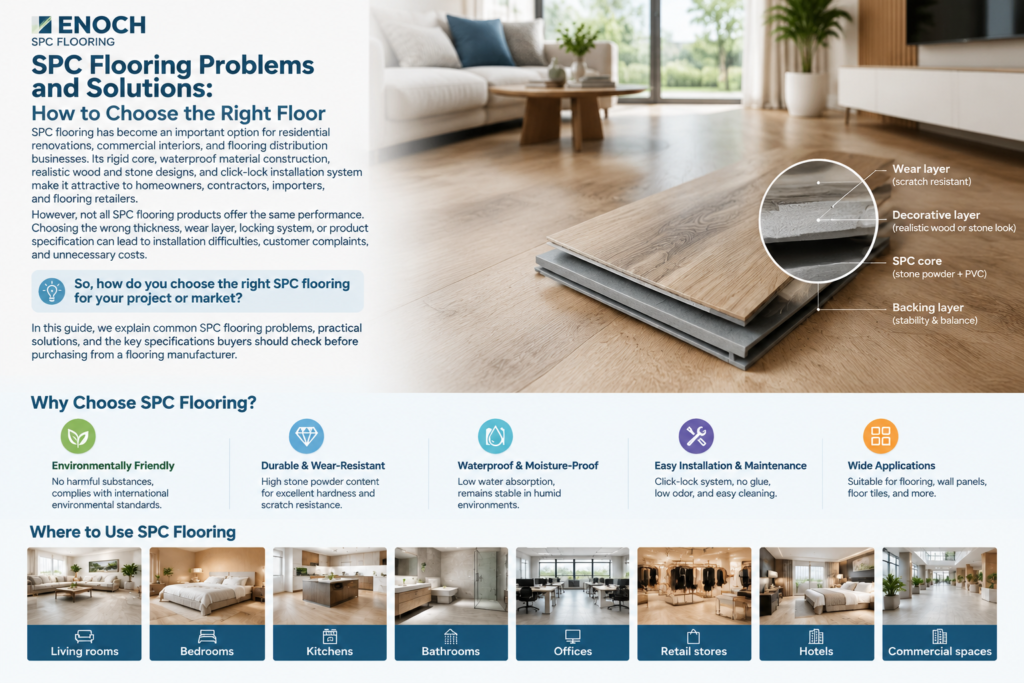
SPC flooring has become an important option for residential renovations, commercial interiors, and flooring distribution businesses. Its rigid core, waterproof material construction, realistic wood and stone designs, and click-lock installation system make it attractive to homeowners, contractors, importers, and flooring retailers.
However, not all SPC flooring products offer the same performance. Choosing the wrong thickness, wear layer, locking system, or product specification can lead to installation difficulties, customer complaints, and unnecessary costs.
So, how do you choose the right SPC flooring for your project or market?
In this guide, we explain common SPC flooring problems, practical solutions, and the key specifications buyers should check before purchasing from a flooring manufacturer.
1. What Are the Most Common SPC Flooring Problems?
SPC flooring offers many practical advantages, but its performance depends on product quality, installation conditions, and the intended application.
The following table summarizes common issues and how to address them.
| Common Problem | Possible Cause | Recommended Solution |
|---|---|---|
| Flooring joints separate | Uneven subfloor, damaged locking edges, or improper installation | Check subfloor flatness and inspect the click-lock system |
| Planks crack at the edges | Weak locking profiles, point loads, or installation errors | Choose a suitable product specification and prepare the subfloor properly |
| Scratches appear on the surface | Abrasive dirt, furniture movement, or an unsuitable wear layer | Select an appropriate wear layer and use protective furniture pads |
| Flooring sounds hollow | Uneven subfloor, unsuitable underlayment, or installation problems | Follow the manufacturer’s subfloor and underlayment requirements |
| Flooring expands or buckles | Insufficient expansion gaps, excessive heat, or restricted movement | Follow installation instructions and maintain appropriate expansion gaps |
| The floor feels too hard | Rigid core construction and insufficient acoustic cushioning | Consider a compatible attached IXPE or other approved underlayment |
| Color or texture differs between batches | Different production batches or inconsistent product specifications | Approve reference samples and confirm color codes before ordering |
Important: SPC flooring is waterproof as a material, but the complete installed floor is not automatically a waterproof barrier. Water may pass through joints, edges, or poorly sealed transitions. Correct installation remains essential.
2. SPC Flooring Thickness: Is 4mm, 5mm, or 6mm Better?
One of the most common questions buyers ask is: What thickness of SPC flooring should I choose?
The answer depends on your budget, application, subfloor conditions, and expected traffic. A thicker plank is not automatically better in every situation.
4mm SPC Flooring
4mm SPC flooring is often suitable for budget-conscious residential projects and price-sensitive distribution markets.
Potential advantages include:
- Lower material cost compared with thicker alternatives.
- Lower product weight, depending on construction and dimensions.
- A practical option for residential rooms with a properly prepared subfloor.
Buyers should pay particular attention to locking quality, subfloor flatness, and the intended traffic level.
5mm SPC Flooring
5mm SPC flooring can offer a practical balance between product cost, rigidity, and everyday residential performance.
It may be suitable for living rooms, bedrooms, apartments, and selected light-commercial applications when the complete product specification meets project requirements.
6mm SPC Flooring
6mm SPC flooring may be worth considering for buyers seeking a more substantial plank construction or a premium product range.
However, the actual performance also depends on core quality, locking geometry, wear layer, and attached underlayment.
| Factor | 4mm SPC | 5mm SPC | 6mm SPC |
|---|---|---|---|
| Material cost | Generally lower | Medium | Generally higher |
| Product rigidity | Depends on construction | Depends on construction | May offer greater rigidity |
| Residential use | Suitable for appropriate applications | Suitable for appropriate applications | Suitable for appropriate applications |
| Commercial use | Depends on traffic and specification | Depends on traffic and specification | Depends on traffic and specification |
| Key consideration | Subfloor and locking quality | Overall specification balance | Cost, installation height, and performance requirements |
When comparing quotations, confirm whether the stated thickness includes the attached IXPE pad. For example, a 5mm plank plus a 1mm pad may have a total thickness of 6mm, but the rigid plank itself remains 5mm thick.
Buyer’s tip: Compare total thickness, core thickness, wear layer, and underlayment separately instead of relying on one number.
3. SPC Flooring Wear Layer: 0.3mm vs. 0.5mm
The wear layer is a transparent protective layer above the decorative film. It helps protect the printed design against everyday abrasion and surface wear.
Choosing the correct wear layer is particularly important for flooring distributors, contractors, and commercial project buyers.
Is a 0.3mm Wear Layer Enough?
A 0.3mm wear layer can be suitable for many residential applications, depending on the product construction, expected use, maintenance, and warranty requirements.
It can be an option for bedrooms, living rooms, and other areas with moderate foot traffic.
When Should You Choose a 0.5mm Wear Layer?
A 0.5mm wear layer may be more appropriate for busy households, rental properties, and selected commercial applications where greater surface protection is required.
For hotels, offices, and retail stores, buyers should evaluate the actual traffic conditions and relevant performance requirements rather than choosing by building type alone.
| Specification | Typical Consideration |
|---|---|
| 0.3mm wear layer | Many residential and value-focused flooring ranges |
| 0.5mm wear layer | Busy residential areas and selected commercial applications |
| 0.7mm wear layer | Certain higher-demand applications, subject to product testing and manufacturer specifications |
A thicker wear layer does not automatically guarantee a better floor. Surface coating quality, locking strength, core construction, installation, and maintenance all influence long-term performance.
Also, do not confuse total plank thickness with wear layer thickness. A 6mm SPC plank can have a 0.3mm wear layer, while a 5mm plank can have a 0.5mm wear layer.
4. Is SPC Flooring Really Waterproof?
Yes, a properly manufactured SPC rigid core is designed to resist water absorption and is widely used in areas where moisture resistance is important.
This is one reason buyers consider SPC flooring for kitchens, living areas, apartments, and selected commercial interiors.
However, there is an important distinction between a waterproof flooring material and a waterproof installed floor system.
Where Can SPC Flooring Be Used?
SPC flooring may be suitable for:
- Living rooms and bedrooms.
- Kitchens and dining areas.
- Apartments and residential renovations.
- Offices and retail stores.
- Hotels and selected hospitality interiors.
Bathrooms and other regularly wet areas require special attention to the manufacturer’s installation instructions, local building requirements, slip resistance, and water management. Do not assume every SPC product is approved for every wet-area application.
How Can You Avoid Moisture-Related Problems?
- Prepare the subfloor according to the manufacturer’s instructions.
- Check the moisture conditions of the subfloor.
- Follow the recommended expansion and transition details.
- Address leaks and standing water promptly.
- Confirm whether the specific product is suitable for the intended environment.
For importers and distributors, it is important to confirm the product’s intended applications before making waterproofing claims to customers.
5. SPC Flooring vs. Laminate Flooring: Which Is Better?
Buyers often compare SPC flooring with laminate flooring when choosing a product for residential or commercial projects.
Neither product is automatically the best choice for every application.
| Comparison | SPC Flooring | Laminate Flooring |
|---|---|---|
| Core construction | Rigid stone-plastic composite core | Commonly wood-based fiberboard core |
| Water resistance | SPC core is highly water-resistant | Water resistance depends on the specific product and construction |
| Installation | Commonly uses click-lock systems | Commonly uses click-lock systems |
| Surface appearance | Realistic wood and stone designs | Realistic wood and other decorative designs |
| Underfoot feel | Generally firm due to rigid core construction | Depends on core, underlayment, and product construction |
| Main selection factors | Moisture exposure, locking quality, wear layer, and installation | Moisture rating, surface durability, core quality, and installation |
Which One Should You Choose?
Consider SPC flooring when moisture resistance, rigid-core construction, and practical maintenance are priorities.
Consider laminate flooring when its surface characteristics, product price, and intended indoor conditions better match your requirements.
For distributors, the best product is the one that meets local customer expectations, target pricing, technical requirements, and warranty obligations.
6. How to Choose SPC Flooring for Commercial Projects
Commercial flooring requires more than an attractive surface design.
Hotels, offices, shops, and other commercial spaces may experience frequent foot traffic, rolling loads, furniture movement, and repeated cleaning.
Before specifying SPC flooring for a project, evaluate the following factors.
Wear Layer and Surface Performance
Choose the wear layer according to expected traffic and maintenance conditions. Ask for relevant test reports when the project requires documented abrasion or surface performance.
Core and Locking System
The locking profile is important because it connects individual planks. Ask the manufacturer about locking-system specifications, applicable testing, and compatibility with the proposed installation.
Acoustic Underlayment
An attached IXPE pad may improve underfoot comfort and help reduce certain impact sounds. Actual acoustic performance depends on the entire floor assembly and the building structure.
Installation Requirements
Confirm subfloor flatness, expansion gaps, installation temperature, transition details, and any restrictions on heavy furniture or rolling loads.
Technical Documentation
For commercial projects, request product data sheets, installation instructions, warranty terms, and relevant test reports or certifications.
A reliable product specification should match the actual project requirements instead of relying on thickness alone.
7. How to Choose a Reliable SPC Flooring Manufacturer in China
For overseas importers, wholesalers, distributors, and project contractors, selecting the right factory can be as important as selecting the flooring itself.
A reliable supplier should provide consistent product specifications, clear communication, and suitable quality-control documentation.
Here are six points to check before placing an order.
1. Confirm manufacturing capability
Ask whether the company manufactures SPC flooring directly or acts as a trading company. Review production facilities, manufacturing processes, and quality-control procedures where possible.
2. Request product samples
Check the surface finish, color, dimensions, plank thickness, attached pad, and click-lock fit. Approve a reference sample before mass production.
3. Confirm the complete specification
Your quotation should identify at least:
- Total plank thickness and whether the pad is included.
- Wear layer thickness.
- Plank dimensions.
- Core and backing construction.
- Surface finish and texture.
- Locking system.
- Packaging and labeling requirements.
4. Check quality-control documentation
Ask which product tests are available and request relevant reports for your target market. Confirm that any claimed certifications or compliance documents apply to the exact product being purchased.
5. Evaluate supply and customization options
If you are building your own brand, discuss available colors, packaging, carton labels, product specifications, and repeat-order consistency.
6. Compare total purchasing costs
Do not compare suppliers by unit price alone. Consider packaging, shipping, product consistency, claims handling, and the cost of potential replacements.
For buyers sourcing from China, these steps can help reduce specification misunderstandings and improve purchasing decisions.
8. Frequently Asked Questions About SPC Flooring
Is SPC flooring good for homes?
SPC flooring can be a practical option for many homes because of its rigid core, moisture resistance, and easy-to-clean surface. Product selection and proper installation remain important.
Does thicker SPC flooring last longer?
Not necessarily. Greater thickness may improve rigidity in some constructions, but service life also depends on the wear layer, locking system, manufacturing quality, traffic, and maintenance.
Is 0.5mm wear layer better than 0.3mm?
A 0.5mm wear layer provides more protective material and may be suitable for higher-demand applications. The correct choice depends on actual use, budget, product construction, and performance requirements.
Can SPC flooring be installed over existing flooring?
Some installations may be possible, but the existing floor must meet the manufacturer’s requirements for stability, flatness, moisture, and compatibility. Loose, uneven, damaged, or unsuitable flooring may need to be removed.
What should I ask an SPC flooring supplier before ordering?
Ask for a complete specification sheet, samples, production tolerances, installation instructions, warranty terms, relevant test reports, packaging details, and a quotation based on your required quantity and delivery terms.
How can I get a quotation for SPC flooring from China?
Prepare your target thickness, wear layer, plank dimensions, surface design, quantity, destination country, and packaging requirements. These details help a manufacturer recommend a suitable specification and calculate a more accurate quotation.
9. Looking for an SPC Flooring Manufacturer?
Choosing the right SPC flooring means balancing product quality, application requirements, appearance, and purchasing cost.
At Enoch, we manufacture SPC flooring and other decorative surface products for international buyers. Whether you are a flooring distributor, importer, contractor, or brand owner, confirming your target specifications is the first step toward finding the right product.
Visit our SPC Flooring Product Page to explore our product range.
Need a quotation or product samples?
Contact Enoch with your target thickness, wear layer, plank size, preferred colors, estimated order quantity, and destination market.
Our team can help you review suitable specifications for your project or distribution business.
Enoch SPC Flooring Factory — Your Partner for Flooring and Decorative Surface Solutions.