SPC Flooring Thickness: Is 4mm, 5mm, or 6mm Better?
Choosing the right SPC flooring thickness is an important decision for flooring importers, wholesalers, distributors, contractors, and project buyers. A product that looks similar to another flooring option may have a different construction, installation requirement, and price.
One of the most common questions buyers ask is whether 4mm, 5mm, or 6mm SPC flooring is the better choice.
The answer depends on the intended application, wear layer, locking system, subfloor condition, attached underlay, and overall product quality. A thicker plank is not automatically better for every project.
In this guide, we compare 4mm, 5mm, and 6mm SPC flooring and explain what buyers should consider before requesting a quotation from a manufacturer.
1. What Does SPC Flooring Thickness Mean?
SPC stands for Stone Plastic Composite. SPC flooring is a type of rigid-core vinyl flooring commonly made with a core containing calcium carbonate, PVC, stabilizers, and other formulation components.
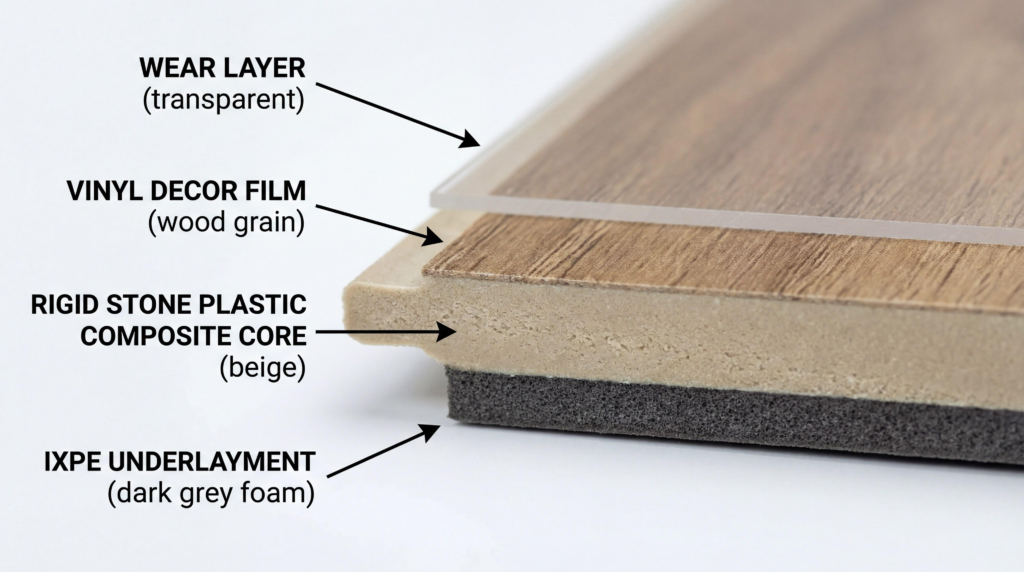
Depending on the product construction, an SPC flooring plank may include several layers:
- UV coating or surface treatment
- Transparent wear layer
- Decorative film
- Rigid SPC core
- Attached IXPE or other underlay, if included
When comparing thickness specifications, buyers should first confirm whether the stated measurement refers to the SPC plank alone or the complete product including the attached underlay.
For example, a product described as 4mm SPC + 1mm IXPE generally means a 4mm SPC plank with an additional 1mm attached underlay, giving a nominal combined thickness of approximately 5mm.
This is different from a product with a 5mm SPC plank and an additional 1mm underlay.
Always ask the supplier to specify the plank thickness and underlay thickness separately.
2. 4mm SPC Flooring: A Practical Option for Cost-Conscious Projects
4mm SPC flooring can be suitable for projects where buyers want to balance product cost, design, and the required performance.
It may be considered for residential renovations, apartments, rental properties, and other applications where the selected product meets the manufacturer’s installation and performance requirements.
Potential advantages
- Competitive material cost compared with some thicker product constructions
- A relatively slim profile for renovation projects
- A range of wood-look colors and decorative finishes may be available
- Options with an attached underlay, depending on the manufacturer
What buyers should check
With thinner SPC flooring, it is particularly important not to evaluate the product based on thickness alone.
Check the quality of the locking system, dimensional consistency, installation requirements, and suitability for the intended subfloor.
If the project involves heavy traffic or demanding commercial use, confirm that the specific product has been tested and approved for that application.
Buyer tip: A 4mm SPC plank with a 1mm attached IXPE underlay is not the same construction as a 5mm SPC plank with a 1mm underlay. Ask for a clear breakdown of the specification before comparing prices.
3. 5mm SPC Flooring: A Versatile Choice for Many Product Collections
5mm SPC flooring is another option buyers may consider when developing a product collection for residential or selected commercial applications.
The final suitability depends on the complete construction rather than the thickness number alone.
Potential advantages
- A useful option for a range of residential product collections
- Availability in different colors, textures, and wear-layer specifications
- Options with attached IXPE underlay, depending on the product range
- Flexibility for importers building several price and specification levels
What buyers should check
A 5mm product does not automatically have a stronger locking system or better wear resistance than every 4mm product.
Buyers should compare the following:
- Wear-layer thickness
- Locking profile and performance
- Core formulation and dimensional stability
- Surface finish and texture
- Underlay construction
- Manufacturer test data and installation instructions
For distributors, 5mm SPC flooring may be a useful product to evaluate alongside thinner and thicker options when planning a balanced product range.
4. 6mm SPC Flooring: When Should Buyers Consider It?
6mm SPC flooring may be worth considering for projects or product collections where a thicker plank is preferred.
However, a thicker product is not automatically suitable for every environment. Its actual performance depends on the product design, manufacturing quality, locking system, and installation conditions.
Potential advantages
- A thicker plank profile for customers who prefer it
- Potentially more construction options, depending on the manufacturer
- A possible fit for selected product ranges and project requirements
What buyers should check
Do not assume that 6mm SPC flooring is always more durable, more waterproof, or more resistant to indentation than a thinner alternative.
These characteristics depend on the full product construction and supporting test data.
A thicker plank may also affect transitions to adjacent flooring, door clearances, and the total installed floor height.
Before choosing 6mm SPC flooring, confirm that the product is appropriate for the intended application and installation conditions.
5. 4mm vs. 5mm vs. 6mm SPC Flooring: Key Differences
The following table provides a general comparison to help buyers organize their evaluation.
| Factor | 4mm SPC | 5mm SPC | 6mm SPC |
|---|---|---|---|
| Plank profile | Slimmer | Medium | Thicker |
| Material cost | May be lower | Depends on construction | May be higher |
| Renovation suitability | Check transition and subfloor requirements | Check transition and subfloor requirements | Check finished floor height carefully |
| Wear resistance | Depends on wear layer and product testing | Depends on wear layer and product testing | Depends on wear layer and product testing |
| Locking performance | Depends on locking design and quality | Depends on locking design and quality | Depends on locking design and quality |
| Best selection method | Match the specification to the project | Match the specification to the project | Match the specification to the project |
Important: This is a general purchasing guide, not a performance ranking. Buyers should compare the technical specifications and test results of the actual products being quoted.
6. Does Wear-Layer Thickness Matter More Than Total Thickness?
Total plank thickness and wear-layer thickness describe different parts of an SPC flooring product.
The total thickness includes the main construction of the plank, while the wear layer is the transparent protective layer above the decorative film.
Common wear-layer options include 0.3mm and 0.5mm, although available specifications vary by manufacturer.
A thicker wear layer may be appropriate for some applications with greater wear demands, but it does not guarantee better performance in every respect. Surface performance also depends on the material, manufacturing process, and relevant testing.
When requesting quotations, clearly state both the total SPC plank thickness and the wear-layer thickness.
For example:
- 4mm SPC flooring with a 0.3mm wear layer
- 5mm SPC flooring with a 0.3mm wear layer
- 5mm SPC flooring with a 0.5mm wear layer
- 6mm SPC flooring with a 0.5mm wear layer
These are example specifications. Confirm actual availability with the manufacturer.
7. How Does Attached IXPE Underlay Affect the Specification?
Some SPC click flooring products come with an attached IXPE underlay.
The underlay may contribute to installation convenience, underfoot comfort, and impact-sound performance, depending on the complete flooring assembly.
However, underlay thickness should not be confused with SPC plank thickness.
For example:
Option A
- SPC plank: 4mm
- Attached IXPE: 1mm
- Nominal combined thickness: approximately 5mm
Option B
- SPC plank: 5mm
- Attached IXPE: 1mm
- Nominal combined thickness: approximately 6mm
These products have different constructions even though their combined thickness may appear similar to other flooring products.
Buyers should also check whether the manufacturer’s installation instructions permit an additional underlay. Using an unapproved extra underlay may affect floor stability or locking performance.
8. How to Choose the Right SPC Flooring for Your Project
Before choosing a thickness, buyers should consider the following factors.
Intended application
Identify whether the product will be used in a house, apartment, retail store, office, hotel, or another environment.
The selected product must be suitable for the expected traffic and installation conditions.
Subfloor condition
SPC flooring still requires the subfloor to meet the manufacturer’s flatness and preparation requirements.
A thicker plank does not eliminate the need for proper subfloor preparation.
Wear-layer requirements
Choose a wear-layer specification based on the intended application and the product’s verified performance.
Do not compare products solely by the thickness of the SPC core.
Locking system
Ask the supplier for information about the locking profile, installation requirements, and available performance tests.
For large projects, evaluate physical samples before confirming the order.
Total installed height
Consider the combined thickness of the plank and underlay, as well as door clearances, transitions, and connections with other flooring materials.
Budget and target market
Importers and distributors should balance product cost, expected market price, quality requirements, and customer preferences.
The best specification is the one that meets the project’s requirements without paying for features that are unnecessary for the intended application.
9. Questions to Ask an SPC Flooring Manufacturer
Before placing an order, ask the manufacturer to confirm:
- Is the quoted thickness for the SPC plank only or the complete product?
- What wear-layer thickness is available?
- Is an IXPE underlay attached, and what is its thickness?
- What plank sizes and surface finishes are available?
- What locking system is used?
- What are the minimum order quantity and production lead time?
- Can the manufacturer provide samples and technical documents?
- What are the packaging details and quotation terms?
Providing these details when requesting a quotation helps suppliers prepare a more accurate offer and makes it easier to compare competing products.
Conclusion: Which SPC Flooring Thickness Is Best?
There is no single SPC flooring thickness that is best for every project.
4mm SPC flooring may be worth evaluating for cost-conscious applications. 5mm SPC flooring can be considered when developing a versatile product collection. 6mm SPC flooring may suit buyers who prefer a thicker plank profile or have specific product requirements.
However, the final decision should always consider the complete construction, wear layer, locking system, installation conditions, and verified product performance.
For importers, wholesalers, distributors, and project buyers, comparing physical samples and complete technical specifications is more useful than choosing a product based on thickness alone.
Looking for an SPC Flooring Manufacturer in China?
Enoch supplies SPC flooring, LVT flooring, SPC wall panels, and UV wall panels for international buyers.
We welcome inquiries from flooring importers, wholesalers, distributors, and construction companies.
Contact us to discuss product specifications, available colors, samples, and bulk-order quotations.
Email: jean@enochfloor.com
WhatsApp: +86 17368120516
Website: https://enochfactory.com
When contacting us, please include your required plank thickness, wear-layer thickness, attached underlay specification, estimated order quantity, and preferred loading port. This will help us recommend a suitable option for your market.