Choose SPC Flooring for Underfloor Heating,When choosing flooring for underfloor heating, the biggest fear is buckling and gaps after a few years. If you are struggling with this decision, SPC (stone plastic composite) rigid-core flooring is currently one of the most reliable options for underfloor heating. It conducts heat quickly and has an extremely low coefficient of thermal expansion—but only if you choose the right specifications and install it correctly. This guide explains everything in one go.
Why SPC Flooring Is Suitable for Underfloor Heating
The core of SPC flooring is made of stone powder and PVC resin. Its thermal conductivity is much higher than solid wood and laminate flooring. Its coefficient of thermal expansion is about 0.02%–0.06%, on the same order of magnitude as tile (about 0.008%) and far lower than laminate flooring (0.1%–0.15%). This means that during the repeated heating and cooling cycles of underfloor heating, SPC flooring changes size very little and has excellent structural stability.
At the same time, SPC flooring is 100% waterproof and moisture-proof. Residual moisture in the underfloor heating screed will not cause the floor to mold or swell. In terms of environmental performance, SPC contains no formaldehyde and does not release harmful substances when heated by underfloor heating. It can withstand temperatures up to 120°C, far above the actual operating temperature of residential underfloor heating.
How to Choose SPC Flooring for Underfloor Heating
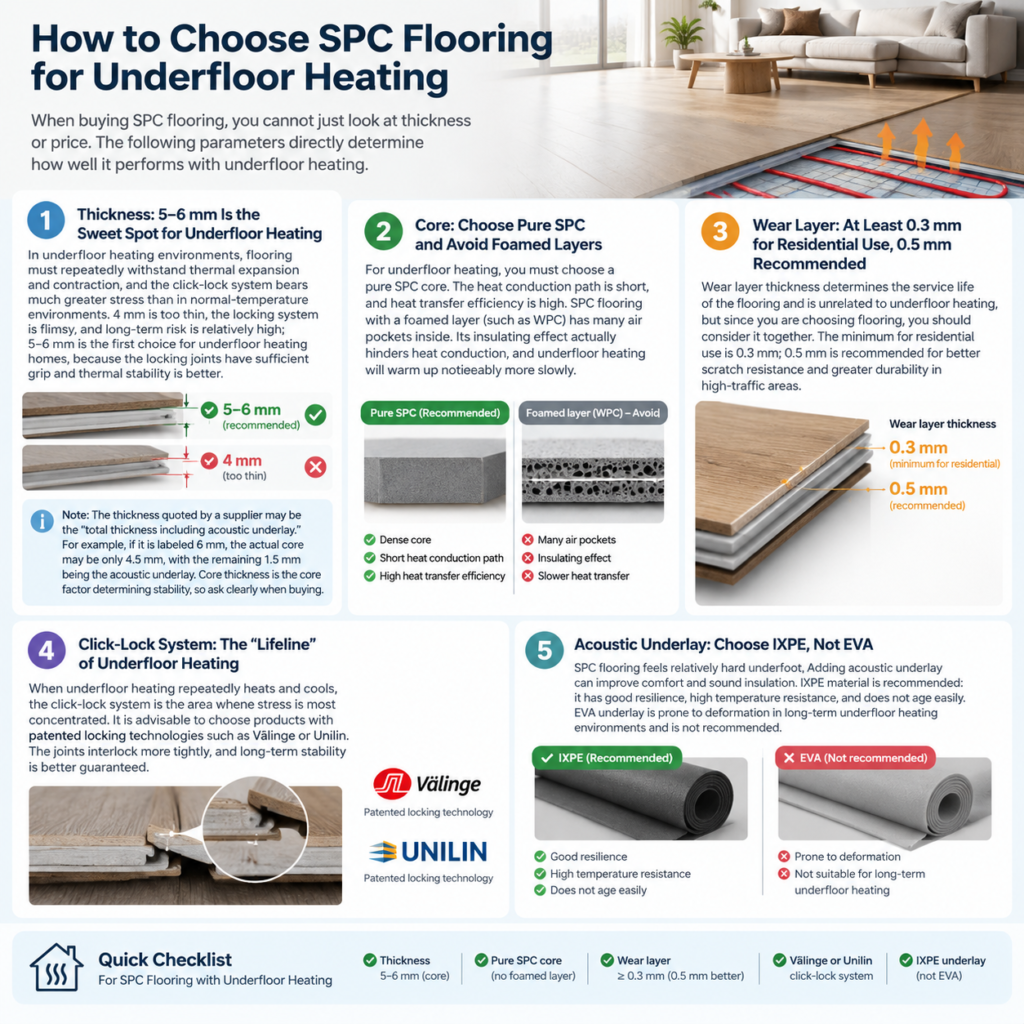
When buying SPC flooring, you cannot just look at thickness or price. The following parameters directly determine how well it performs with underfloor heating.
Thickness: 5–6 mm Is the Sweet Spot for Underfloor Heating
In underfloor heating environments, flooring must repeatedly withstand thermal expansion and contraction, and the click-lock system bears much greater stress than in normal-temperature environments. 4 mm is too thin, the locking system is flimsy, and long-term risk is relatively high; 5–6 mm is the first choice for underfloor heating homes, because the locking joints have sufficient grip and thermal stability is better.
Note: The thickness quoted by a supplier may be the “total thickness including acoustic underlay.” For example, if it is labeled 6 mm, the actual core may be only 4.5 mm, with the remaining 1.5 mm being the acoustic underlay. Core thickness is the core factor determining stability, so ask clearly when buying.
Core: Choose Pure SPC and Avoid Foamed Layers
For underfloor heating, you must choose a pure SPC core. The heat conduction path is short, and heat transfer efficiency is high. SPC flooring with a foamed layer (such as WPC) has many air pockets inside. Its insulating effect actually hinders heat conduction, and underfloor heating will warm up noticeably more slowly.
Wear Layer: At Least 0.3 mm for Residential Use, 0.5 mm Recommended
Wear layer thickness determines the service life of the flooring and is unrelated to underfloor heating, but since you are choosing flooring, you should consider it together. The minimum for residential use is 0.3 mm; 0.5 mm is recommended for better scratch resistance and greater durability in high-traffic areas.
Click-Lock System: The “Lifeline” of Underfloor Heating
When underfloor heating repeatedly heats and cools, the click-lock system is the area where stress is most concentrated. It is advisable to choose products with patented locking technologies such as Välinge or Unilin. The joints interlock more tightly, and long-term stability is better guaranteed.
Acoustic Underlay: Choose IXPE, Not EVA
SPC flooring feels relatively hard underfoot. Adding acoustic underlay can improve comfort and sound insulation. IXPE material is recommended: it has good resilience, high temperature resistance, and does not age easily. EVA underlay is prone to deformation in long-term underfloor heating environments and is not recommended.
Pitfalls to Avoid: Common Problems and Causes
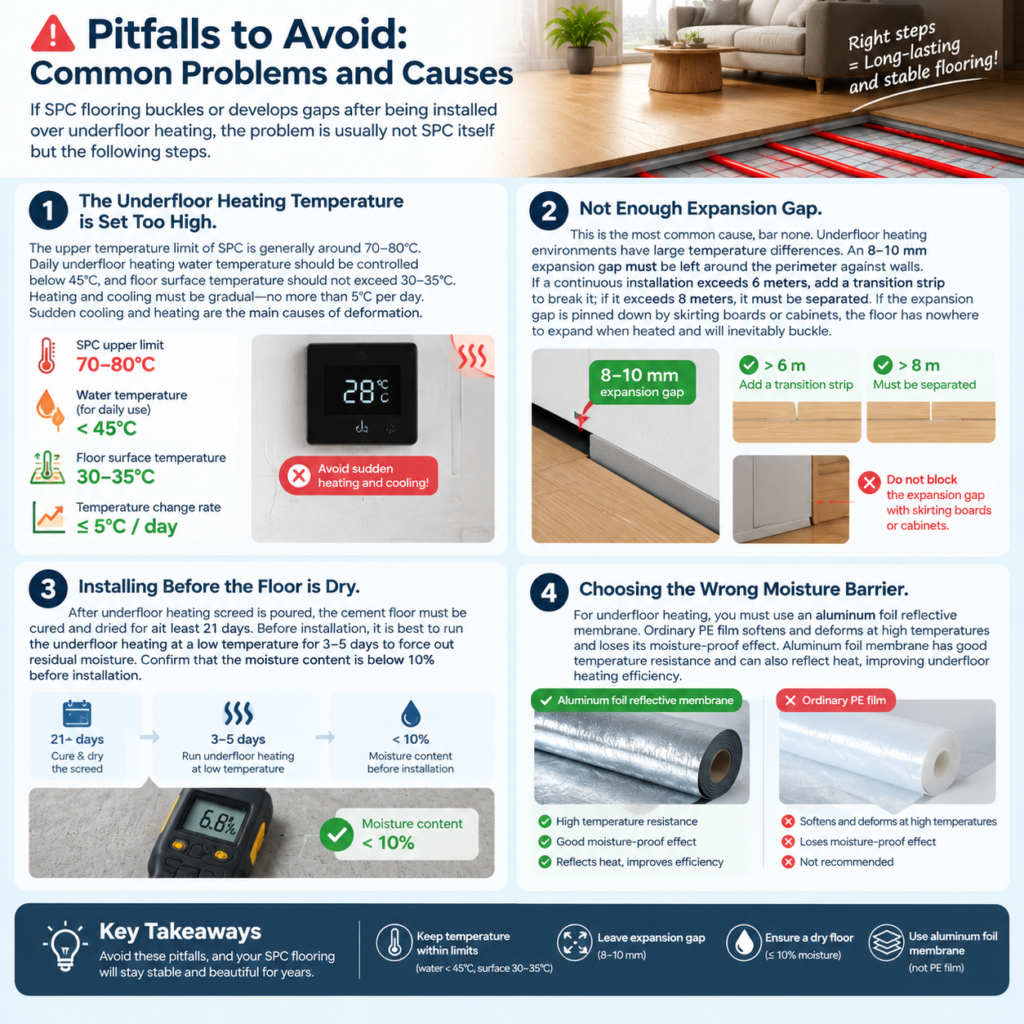
If SPC flooring buckles or develops gaps after being installed over underfloor heating, the problem is usually not SPC itself but the following steps:
① The underfloor heating temperature is set too high. The upper temperature limit of SPC is generally around 70–80°C. Daily underfloor heating water temperature should be controlled below 45°C, and floor surface temperature should not exceed 30–35°C. Heating and cooling must be gradual—no more than 5°C per day. Sudden cooling and heating are the main causes of deformation.
② Not enough expansion gap. This is the most common cause, bar none. Underfloor heating environments have large temperature differences. An 8–10 mm expansion gap must be left around the perimeter against walls. If a continuous installation exceeds 6 meters, add a transition strip to break it; if it exceeds 8 meters, it must be separated. If the expansion gap is pinned down by skirting boards or cabinets, the floor has nowhere to expand when heated and will inevitably buckle.
③ Installing before the floor is dry. After underfloor heating screed is poured, the cement floor must be cured and dried for at least 21 days. Before installation, it is best to run the underfloor heating at a low temperature for 3–5 days to force out residual moisture. Confirm that the moisture content is below 10% before installation.
④ Choosing the wrong moisture barrier. For underfloor heating, you must use an aluminum foil reflective membrane. Ordinary PE film softens and deforms at high temperatures and loses its moisture-proof effect. Aluminum foil membrane has good temperature resistance and can also reflect heat, improving underfloor heating efficiency
One-Sentence Summary
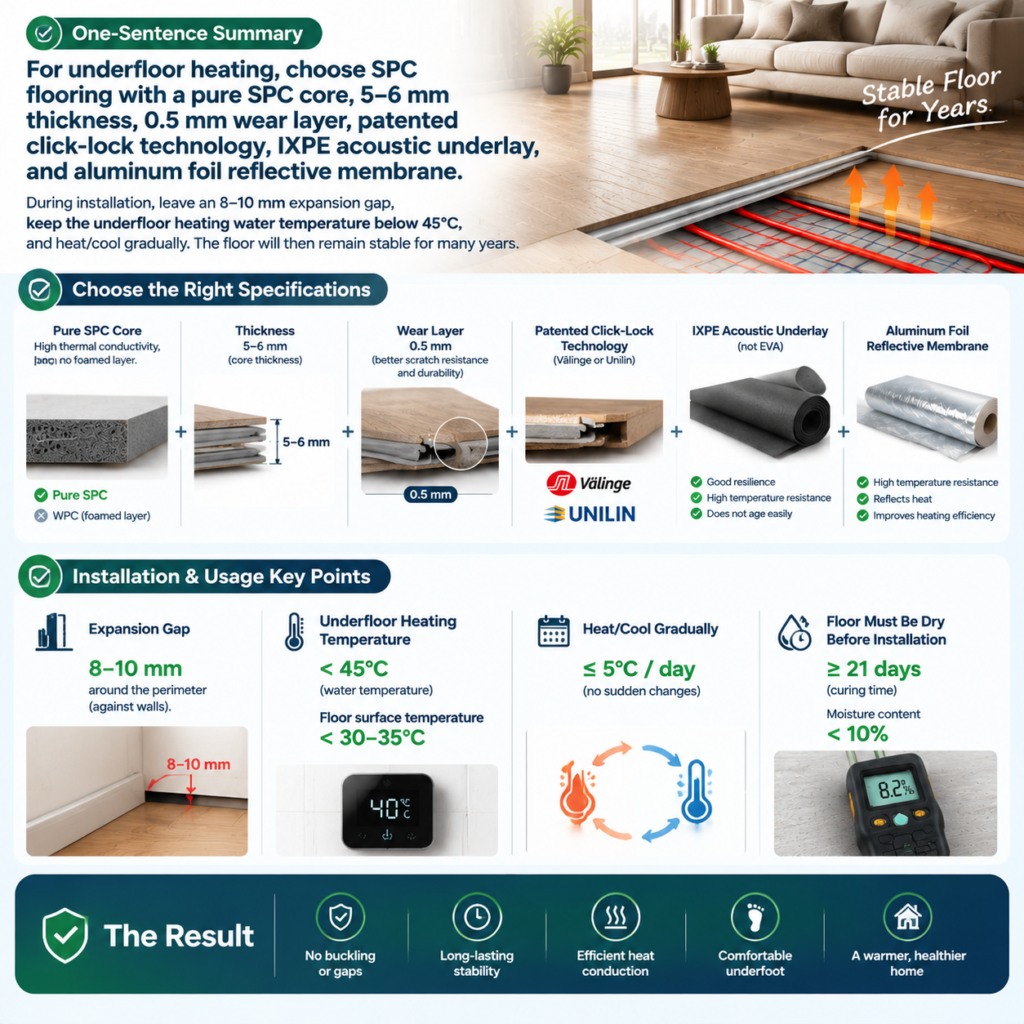
For underfloor heating, choose SPC flooring with a pure SPC core, 5–6 mm thickness, 0.5 mm wear layer, patented click-lock technology, IXPE acoustic underlay, and aluminum foil reflective membrane. During installation, leave an 8–10 mm expansion gap, keep the underfloor heating water temperature below 45°C, and heat/cool gradually. The floor will then remain stable for many years.